hello world!

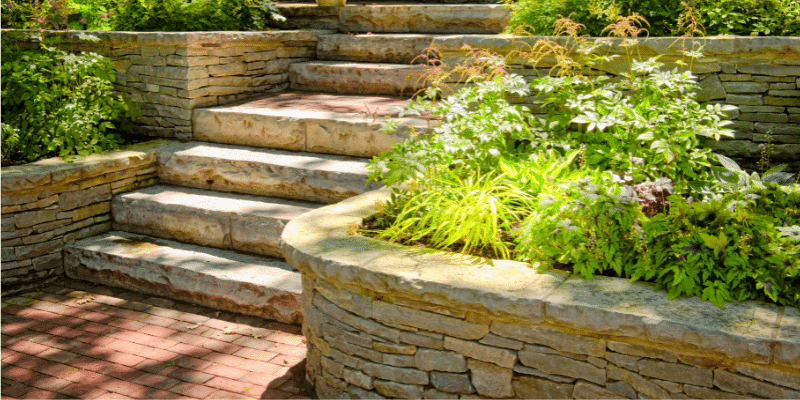
Garden retaining wall applications range from purely practical to purely decorative, and most walls do a bit of both. A garden retaining wall holds back soil to stop erosion, carves flat, plantable space out of a slope, and defines the shape of a yard, all while adding structure a flat lawn cannot. This guide covers the most common and useful applications for Southern Ontario properties. For a wider look at wall styles and materials, see our guide to retaining wall design trends.
Tell us what you’re working on and our team will help you source the right landscape and building supplies for your project anywhere in Southern Ontario.
Terracing is the single most common garden retaining wall application in this region. Many properties near the Niagara Escarpment and through the Dundas Valley sit on grades that are difficult to plant or use, and a series of stepped walls turns that slope into level benches for planting, seating, or lawn.
Terracing also does real structural work. The Government of Ontario notes that erosion risk rises as a slope gets longer and steeper, and that interrupting a long slope reduces the runoff energy that carries topsoil away. The United States Department of Agriculture documents the same principle for backyard terracing. Each bench captures water where plants can use it rather than letting it rush downhill.
A low retaining wall is the backbone of a raised garden bed. Walls built from retaining wall stones contain soil at a comfortable working height, improve drainage for vegetables and perennials, and keep planting areas cleanly separated from lawn and pathways. Raised beds also warm up earlier in spring, which matters in Ontario's shorter growing season, and a wall only a few courses high is often all it takes.
Not every garden retaining wall holds back a meaningful load. Low garden walls work as clean borders between planting beds, lawns, walkways, and patios, giving a yard a sense of order and permanence that plastic or metal edging never achieves. These low borders pair naturally with natural stone landscaping elsewhere in the yard, tying beds, paths, and patios together through shared material and colour.
On a sloped or graded lot, a circular or curved retaining wall built around an existing tree protects its root zone while holding back soil at the new grade. The same idea scales down to built-in planters, which homeowners use to add greenery to patios, entryways, and seating areas without giving up ground space.
A retaining wall built to roughly bench height doubles as seating around a patio, fire feature, or garden gathering space, blurring the line between structure and furniture without cluttering the yard. Capped with a smooth coping stone, it becomes a comfortable, permanent place to sit.
Material shapes how a garden retaining wall performs and looks. This quick comparison covers the most common choices for garden applications.
| Material | Best Garden Application | Look |
| Armour stone | Terracing, larger structural walls | Bold, natural |
| Segmental blocks | Raised beds, seat walls, terraces | Uniform, modern or traditional |
| Natural flagstone | Low borders, informal walls | Rustic, organic |
Whatever the material, a garden wall is only as good as what sits behind and beneath it. A compacted, well-prepared base and a clear drainage path are what carry a wall through Ontario's freeze-thaw cycles, regardless of height.
Terracing a sloped yard is the most common application in Southern Ontario. It converts a slope that is hard to plant or mow into level, usable benches, which is why it is often the first project tackled on graded lots near the escarpment.
Yes. Even low garden walls need a drainage path behind them. Clear stone backfill and a way for water to escape prevent the hydrostatic pressure that pushes walls out of position over time.
Permit thresholds depend on height, location, and local bylaws, and they vary by municipality. Low garden walls and raised beds set back from property lines and carrying no load above typically fall below the threshold, but it is always best to confirm with your local building department first.
The right garden retaining wall application comes down to what a yard needs, whether that is taming a slope, framing a bed, or adding built-in seating. With quality materials on a properly prepared base, a garden wall performs beautifully for decades.
Hamilton Builders' Supply has supplied retaining wall materials across Southern Ontario for over a century. Visit one of our locations in Hamilton, Burlington, Winona, and St. Catharines to see materials in person, or contact us for a quote on your project.